
Lighting engineers reviewing LED optics

A disciplined selection story

Samsung LED keeps professional lighting decisions measurable

Since operations were established in 1996, the working principle has stayed direct: separate essential project constraints from optional preferences, document the resulting choice and preserve enough technical context for downstream review.
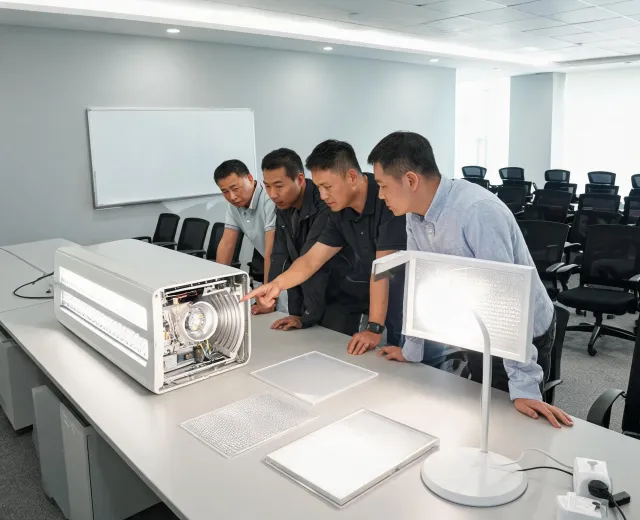
From component knowledge to project clarity

Lighting projects often lose time between a designer's visual intent, an engineer's compliance checks and procurement's availability questions. Samsung LED's role is to make those handoffs more precise. A selection record connects the exact optical distribution to mounting geometry, links the driver interface to the controls sequence and notes environmental boundaries before a product reaches the schedule.

The approach favors concise documents over inflated claims. In a typical office review, for example, the team starts with ceiling module, workplane target and UGR objective; only then does it compare output packages, CCT, CRI and dimming. For a warehouse, mounting height, aisle geometry, surge exposure and maintenance access change the order of questions. The procedure adapts, but the record remains auditable.

"A shorter shortlist is useful only when every exclusion can be explained."

Internal specification principle used for project screening.

Working values

Measure

Use photometric and electrical parameters tied to the actual configuration.

Disclose

State thermal, environmental and maintenance boundaries alongside benefits.

Coordinate

Keep luminaire, driver, sensor and commissioning responsibilities visible.

Record

Preserve calculation assumptions and file revisions for later verification.

Lighting workshop for facility teams

Useful knowledge at the handover point

Project support includes plain-language explanations for facility and installation teams: how to identify a driver interface, why an exact photometric file matters, what an ingress rating does and does not cover, and which maintenance conditions affect rated life. These topics reduce avoidable substitutions after design approval.

In 2026, the documented workflow covers three named compliance references in the current brand record—UL, CE and RoHS—and serves project discussions across 72 markets. Those figures describe organizational reach, not a blanket claim that every configuration carries every mark. Product-level documentation remains the deciding evidence.

Discuss a real fixture schedule

Share what is fixed, what remains open and which approvals control the selection.